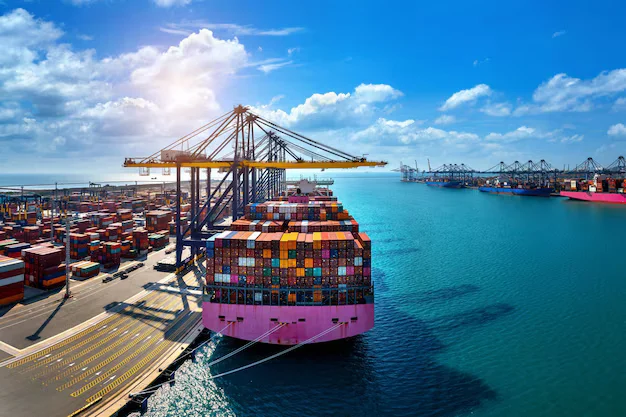
What is customs duty? As soon as the imported goods arrive, the funds received at the customs are subjected to a careful allocation process and follow specific objectives that help the economic vitality of the countries to flourish.
The most important of these allocations are the customs duty and costs , which include a form of indirect tax. Additionally, fees are charged for valuable services rendered. These services include a range of essential activities such as unloading and loading, rigorous testing, standard enforcement and safe storage.
Duties and responsibilities are divided in this process: the duties themselves, which are imposed by the customs authorities, and the fees, which are collected by the respective service providers.
These providers, including port organizations located at the nation’s sea gates, public warehouses strategically located in the inland customs area, and leading national standards organizations, expertly oversee and facilitate these core functions.

Delving further into the realm of customs duty, we come across the import platform: customs duty with two distinct facets. The initial payment includes customs duty. The second dimension includes commercial profit, a dynamic element regulated by the state monopoly. The fluidity of this profit is essential because it is compatible with the evolving contours of the economic landscape of the countries and at the same time it shows the intelligence and ingenuity of the governments in balancing the income and commercial dynamics.
In fact, the coordination of these elements not only strengthens revenue generation, but also emphasizes the commitment of countries to provide skilled services, legislative wisdom and adaptation to economic nuances.
This process acts as a cornerstone and strengthens the foundations of each country’s national economy and elevates the customs landscape to new heights of efficiency, transparency and attractiveness for global trade.
What is customs duty?
Within the scope of customs, an important financial flow of imported goods flows, consisting of duties and import customs duty. These financial contributions, called entry rights, represent a type of indirect tax that is a symbol of our country’s commitment to a balanced economy. This realm of financial flow finds its custodian in Customs, the strict guardian of financial integrity.
Customs duty refers to a set of regulations and laws related to trade exchanges between countries. These rights are approved in order to manage and monitor the movement of goods and services from one country to another, import and export, and regulate customs and financial issues related to these exchanges.
Meran Blue Gulf
However, in the organization of the customs financial sphere, a set of costs is harmoniously associated with import duties, each of which is imbued with targeted mutual services. Amidst these charges, governments are faced with a range of essential services whose nature may resonate with the preservation of their national interests.
These services cover a wide range of functions, from looking closely at x-rays to ensure security and compliance, to accurately calculating shipping costs, and protecting goods in secure warehouses. The spectrum expands further to include rigorous testing, the enforcement of unwavering standards, and accurate weight determination, each a vital discipline in the complex fabric of commerce.
This symphony of fiscal engagement, in which import duties are harmonized with precisely defined costs for a range of vital services, embodies the countries’ commitment to fiscal prudence, service excellence and economic balance.
Additional taxes and duties, which are complexly adjusted according to the nature and volume of imported goods, include the following:
- Value added tax
- A percentage contribution to domestic organizations, which is clearly linked to the cost of entry.
- Tax on cultural goods, which means cultural investment.
- Occasional costs related to waste, in the field of importing goods.
Difference between customs tariff and customs duty
The core of the tariff system lies in its numerical nature – an 8-digit based code that intricately places each commodity within the realm of clearance protocols. Underlying this numerical classification is the customs tariff, a central instrument through which the government collects financial resources.
The treasury is full of duties and taxes, both independently and as a combination of financial mechanisms. In short, this inflow is known as customs duty – evidence of the financial backbone of international trade. Customs duty take multifaceted forms, the assessment of which is often rooted in the valuation of the goods in question. In cases where the value resonates, this criterion is used to determine the quantum of duty.
In pursuit of simplicity, a compact formula for input duties emerges:
Import duty = 4% customs duty + commercial profit + additional duties
This formula captures the nature of the calculation of customs duties and maintains numerical integrity while concisely specifying the components that combine to form fiscal duties.
What is business profit?
A unique financial component lies in the complex layers of customs: trade profits. A custom entry is granted solely for selected imports, indicating the origination of this specialized income stream. This receipt, which is a testament to strategic financial maneuvers, is realized under the watchful eye of governments’ discretion.
The supervision of this financial tribute is entrusted to the customs department, whose task is to accurately collect the commercial profit from the territory of imported goods. It should be mentioned that these financial accrual items are formed in foreign currency
Significantly, the liquidity of trading profits is expressed in government-regulated volatility. On top of this financial freedom, the government has the privilege to increase or decrease the commercial profit attributable to any commodity. This power stands as a testament to the shrewd adaptability of governance, manifested through calculated policy interventions as circumstances dictate.

What are the factors affecting the increase in customs duty?
In the complex web of customs law, a symphony of factors converge to fine-tune the financial obligations imposed on goods entering a country’s territory. These factors, similar to regulated instruments, play an important role in shaping the complex dance of financial transactions. Let us introduce these tool elements:
- Product Type: A basic cornerstone, the nature of the product in question – defined by its HS code – forms the basis of the tariff to be borne. This code symbolizes the nature of the product, the course charter for its financial commitment.
- Quantity of Goods: A deep resonance emerges with the quantity of imported goods. With each invasion, a tangible reverberation is felt in the area of government revenues. As the quantity increases, so does the value, which is inevitably reflected in the increase in customs duty.
- Product volume: The dimensions have a transformative effect. Some goods, with their compactness, require the least amount of space during transportation and storage. Such goods enjoy the luxury of reduced costs, as efficient use of space entails reduced warehousing costs. The volume to cost ratio is reflected in this delicate balance.
- Mode of transport: The channels through which the goods pass have a definite effect. Hailed for its expediency, air freight speeds the arrival of goods beautifully. However, this price carries a premium that increases the value of the safe and thus the amount collected.
- Duration of storage: The time dimension is equally influential. Long-term stay in storage areas increases costs, which is reflected in relatively high tolls.
- Trade agreements: The international structure of trade agreements is intertwined in this dynamic. Agreements that involve diplomatic channels can shift taxes in favor of or with partner countries, exercising economic synergies.
- Domestic production context: The domestic landscape itself contributes to this financial dance. Domestically booming goods can create altered tariffs and boost domestic competition while moderating imports.
- Collectively, these factors create a complex narrative that moves across the tapestry of international trade. Their fusion brings customs law to life, and each note reflects economic aspirations, strategic acumen, and responsive governance.
last words
Introducing Meran Group: Your best partner in the field of import, export and customs clearance
Embark on a seamless international business journey with the Meran Group – the pinnacle of expertise in import, export and customs clearance. With an outstanding 30-year history of excellence, our group stands as a beacon of unwavering expertise, ready to transform your business operations on the global stage.
Your business aspirations deserve nothing less than the best, and our team’s deep expertise ensures that your investments stay on the winning track. Join the Meran Group and unlock a world of opportunity, where excellence is not just a goal, but a standard we live by.
Meran Group
Resources: us. customs and border protection | int trade administration.gov