

In the increasingly competitive landscape of global trade, pricing optimization has emerged as a critical determinant of export success. Traditional pricing strategies, often based on cost-plus models or competitor benchmarking, are proving inadequate in today’s dynamic markets. Artificial Intelligence (AI) is revolutionizing export pricing by enabling data-driven, dynamic, and predictive approaches that maximize profitability while maintaining competitiveness. This comprehensive analysis explores how AI technologies are transforming export pricing strategies, supported by real-world case studies, statistical evidence, and implementation frameworks for businesses seeking to enhance their international market positioning.
The Pricing Challenge in Global Export Markets

Export pricing represents one of the most complex decisions in international business, influenced by a multitude of factors including currency fluctuations, tariff structures, competitor actions, demand elasticity, logistical costs, and regulatory constraints. According to a 2024 McKinsey Global Institute report, suboptimal pricing decisions cost global exporters approximately $280 billion annually in lost revenue and margin erosion.
The traditional approach to export pricing typically involves:
- Cost-plus pricing with standardized markups
- Competitor-based pricing without dynamic adjustment
- Regional price differentiation based on broad market categories
- Infrequent price reviews (quarterly or annually)
These methods fail to capture real-time market dynamics and often result in either leaving money on the table (through underpricing) or losing market share (through overpricing). AI-powered pricing optimization addresses these limitations by processing vast datasets and identifying optimal price points for specific markets, customer segments, and products.
MORE: Emerging Markets Export Strategies 2025: Navigating New Frontiers in Global Trade
How AI Transforms Export Pricing Strategies
1 Dynamic Pricing Algorithms and Real-Time Adjustment
AI enables continuous price optimization through algorithms that analyze multiple variables simultaneously:
Multi-Factor Analysis: AI systems process data from diverse sources including:
- Historical sales data and price elasticity patterns
- Real-time competitor pricing across global markets
- Currency exchange rate fluctuations and forecasts
- Tariff and duty changes by destination country
- Shipping and logistics cost variations
- Market demand signals and economic indicators
Case Study: German Automotive Parts Manufacturer
A leading German automotive parts exporter implemented an AI pricing system that resulted in:
- 17% increase in overall export profitability
- 23% reduction in price-related customer attrition
- 34% improvement in price realization compared to list prices
The system adjusted prices daily based on currency movements, competitor actions in each target market, and inventory levels across distribution centers.
2 Predictive Analytics for Price Elasticity Modeling
AI excels at predicting how price changes will affect demand in specific export markets:
Machine Learning Models: Advanced algorithms analyze historical transaction data to build sophisticated price elasticity models that account for:
- Product category and substitution effects
- Customer segment sensitivity
- Seasonal demand patterns
- Economic conditions in target countries
- Competitive landscape dynamics
Expert Insight: Dr. Michael Chen, pricing analytics expert at Harvard Business School, notes:
“AI-driven elasticity models have revealed that export markets often exhibit dramatically different price sensitivities than domestic markets. What works in Germany may fail completely in Vietnam, and AI helps identify these nuances at a granular level.”
3 Competitive Intelligence and Market Positioning
AI systems provide unparalleled competitive monitoring capabilities:
Global Competitor Tracking: Natural Language Processing (NLP) algorithms scan thousands of sources including competitor websites, trade portals, and market reports to extract pricing intelligence across multiple languages and currencies.
Price Positioning Optimization: AI recommends optimal price positioning relative to competitors based on:
- Product feature differentiation
- Brand perception and reputation
- Service level agreements
- Market share objectives
Key AI Technologies in Pricing Optimization
1 Machine Learning Algorithms for Price Prediction
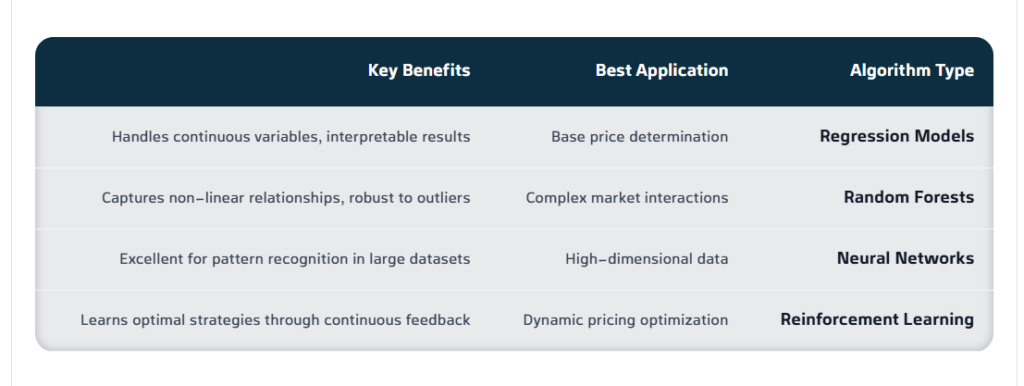
Several ML approaches are particularly effective for export pricing:
2 Natural Language Processing for Market Intelligence
NLP technologies extract valuable insights from unstructured data:
- Sentiment analysis of customer reviews and feedback
- Monitoring of regulatory announcements affecting pricing
- Analysis of competitor marketing materials and positioning
- Extraction of pricing terms from contracts and tenders
3 Optimization Algorithms for Portfolio Pricing
AI optimizes pricing across entire product portfolios considering:
- Cross-product cannibalization effects
- Bundle pricing strategies
- Volume discount structures
- Channel-specific pricing (direct vs. distributor)
Implementation Case Studies and ROI Analysis
1 Multinational Consumer Electronics Exporter
Challenge: A South Korean electronics manufacturer faced margin pressure across 85 export markets with inconsistent pricing strategies.
AI Solution: Implemented a cloud-based AI pricing platform integrating:
- Real-time competitor price monitoring in 35 languages
- Currency risk hedging recommendations
- Country-specific regulatory compliance checks
- Demand forecasting for production planning
Results (18-month implementation):
- Average price increase of 8.2% without volume loss
- Margin improvement of 4.7 percentage points
- Reduction in pricing administration by 65%
- ROI: 3.2x return on technology investment
2 Agricultural Commodities Trader
Challenge: A Brazilian agricultural exporter struggled with volatile commodity prices and thin margins.
- AI Solution: Developed a proprietary AI system that:
- Analyzed global supply-demand imbalances
- Predicted price movements based on weather patterns
- Optimized contract timing and pricing terms
- Identified premium market segments willing to pay more for certified sustainable products
Results:
- 15% improvement in price realization compared to market averages
- 22% reduction in price volatility impact on revenues
- Identification of 12 new premium market segments with 30% higher margins
3 Pharmaceutical Export Specialization
Challenge: A Swiss pharmaceutical company needed to navigate complex pricing regulations across 120 countries.
AI Solution: Implemented a regulatory-aware AI pricing system that:
- Continuously monitored healthcare policy changes
- Calculated country-specific reference pricing constraints
- Optimized patient access program pricing
- Ensured compliance with international pricing transparency requirements
Results:
- 100% regulatory compliance across all markets
- Optimized market access in 18 previously challenging countries
- 7% increase** in emerging market revenues through improved pricing strategies
Technical Implementation Framework
1 Data Infrastructure Requirements
Successful AI pricing implementation requires robust data foundations:
Internal Data Sources:
- Historical transaction data with price, volume, and customer details
- Product cost structures and bill of materials
- Customer segmentation and profitability analysis
- Sales channel performance metrics
External Data Integration:
- Real-time currency exchange rates and forecasts
- Competitor pricing data from web scraping and market intelligence
- Economic indicators and market reports
- Regulatory and tariff databases
- Logistics and shipping cost feeds
Data Quality Management: Implementing data validation, cleansing, and enrichment processes to ensure AI model accuracy.
2 AI Model Development Lifecycle
A structured approach to AI pricing model development:
- Problem Definition: Clearly define pricing objectives (maximize margin, increase market share, etc.)
- Data Preparation: Collect, clean, and feature engineer relevant data
- Model Selection: Choose appropriate algorithms based on data characteristics and business objectives
- Training and Validation: Train models on historical data and validate performance
- Deployment: Integrate models into pricing workflows with appropriate guardrails
- Monitoring and Optimization: Continuously monitor model performance and retrain as needed
3 Integration with Existing Systems
AI pricing solutions must integrate with:
- Enterprise Resource Planning (ERP) systems
- Customer Relationship Management (CRM) platforms
- Supply Chain Management (SCM) systems
- Business Intelligence (BI) and reporting tools
- Existing pricing and quotation systems
Challenges and Risk Mitigation
1 Implementation Barriers and Solutions
Data Quality and Availability:
- Challenge: Incomplete or inconsistent historical pricing data
- Solution: Implement data governance programs and consider synthetic data generation for training
Organizational Resistance:
- Challenge: Sales teams reluctant to adopt AI-driven pricing recommendations
- Solution: Change management programs, pilot projects with clear success metrics, and incentive alignment
Regulatory Compliance:
- Challenge: Ensuring AI pricing doesn’t violate competition laws or price discrimination regulations
- Solution: Build compliance checks into AI systems and maintain human oversight for sensitive decisions
Technical Complexity:
- Challenge: Integrating AI with legacy systems and ensuring scalability
- Solution: API-first architecture, cloud-based deployment, and phased implementation approach
2 Ethical Considerations in AI Pricing
As AI takes on greater pricing authority, ethical considerations become paramount:
Price Discrimination Concerns: Ensuring AI doesn’t unfairly discriminate against specific customer segments or regions.
Transparency and Explainability: Developing AI systems that can explain pricing recommendations to build trust with customers and regulators.
Bias Mitigation: Regular auditing of AI models to detect and correct biases in training data or algorithms.
Future Trends and Evolution
1 Convergence with Complementary Technologies
The future of AI pricing lies in integration with other technologies:
AI + Blockchain: Creating transparent, auditable pricing records across supply chains.
AI + Internet of Things (IoT): Dynamic pricing based on product usage data and condition monitoring.
AI + Advanced Analytics: Enhanced forecasting through integration with macroeconomic models and scenario planning tools.
2 Autonomous Pricing Systems
Emerging trends point toward increasingly autonomous pricing:
Self-Optimizing Algorithms: AI systems that continuously learn and adapt without human intervention.
Cross-Channel Price Synchronization: Automated price consistency across online marketplaces, distributor portals, and direct sales channels.
Predictive Price Negotiation: AI agents that can conduct price negotiations with customers or procurement systems.
3 Market Projections and Adoption Timeline
According to Gartner research, AI adoption in pricing is accelerating:
- 2024: 25% of large exporters using some form of AI in pricing
- 2026: 45% adoption among mid-sized exporters
- 2028: 70% of global trade value influenced by AI pricing decisions
The global market for AI in pricing optimization is projected to grow from $2.1 billion in 2024 to $8.7 billion by 2029, representing a CAGR of 32.8%.
Strategic Implementation Roadmap
For exporters considering AI pricing adoption, we recommend this phased approach:
Phase 1: Foundation Building (Months 1-4)
- Conduct pricing maturity assessment
- Identify priority products and markets for AI implementation
- Establish data governance and quality frameworks
- Select pilot project with clear success metrics
Pilot Implementation (Months 5-8)
- Deploy AI pricing for selected product-market combinations
- Train users and establish feedback mechanisms
- Measure performance against control groups
- Refine algorithms based on initial results
Phase 3: Scaling and Integration (Months 9-15)
- Expand AI pricing across additional products and markets
- Integrate with enterprise systems and workflows
- Develop internal AI expertise and center of excellence
- Establish continuous improvement processes
Phase 4: Optimization and Innovation (Months 16+)
- Implement advanced AI capabilities (predictive, autonomous)
- Explore integration with complementary technologies
- Develop proprietary AI models for competitive advantage
- Expand into new pricing applications (promotions, contracts)
Conclusion

Artificial Intelligence is fundamentally transforming how exporters approach pricing decisions. By leveraging vast datasets and sophisticated algorithms, AI enables more precise, dynamic, and profitable pricing strategies that adapt to rapidly changing global market conditions. While implementation challenges exist, the substantial benefits demonstrated by early adopters—including significant margin improvements, reduced administrative burden, and enhanced competitive positioning—make AI pricing optimization an essential capability for exporters seeking sustainable growth in increasingly competitive international markets.
In today’s hyper-competitive global markets, pricing excellence is not optional—it’s essential for survival and growth. AI-powered pricing optimization represents the next frontier in export competitiveness, offering unprecedented precision, responsiveness, and profitability. Begin your AI pricing journey with a comprehensive assessment of your current pricing maturity and potential improvement opportunities. Our specialized consulting team combines deep pricing expertise with AI implementation experience across multiple export sectors. Contact us today for a complimentary pricing diagnostic and discover how AI can transform your export pricing strategy.
The transition from traditional to AI-driven pricing represents not just a technological upgrade but a strategic transformation that requires careful planning, organizational change management, and ongoing optimization. Exporters that embrace this transformation will gain significant competitive advantages in pricing precision, market responsiveness, and profitability optimization.
Frequently Asked Questions (FAQ)
How quickly can we expect to see ROI from AI pricing implementation?
Most organizations achieve positive ROI within 6-12 months, with full payback typically occurring within 18-24 months. The exact timeline depends on implementation scope, data quality, and organizational adoption speed.
Can small and medium-sized exporters afford AI pricing solutions?
Yes, the democratization of AI technology has made solutions accessible to businesses of all sizes. Cloud-based AI pricing platforms with subscription models allow SMEs to access sophisticated capabilities without large upfront investments.
How does AI pricing handle ethical considerations and regulatory compliance?
Modern AI pricing systems include built-in compliance checks, audit trails, and explainability features. Human oversight remains essential for sensitive decisions, and regular ethical reviews should be part of implementation governance.
What skills are needed to implement and manage AI pricing systems?
Successful implementation requires a cross-functional team including pricing analysts, data scientists, IT specialists, and business stakeholders. Many organizations start with external expertise and gradually build internal capabilities.
How does AI pricing integrate with human pricing teams?
AI augments rather than replaces human expertise. The optimal approach combines AI’s data processing capabilities with human judgment, market knowledge, and strategic thinking. AI provides recommendations that humans review, adjust, and approve based on broader business considerations.


