International trade documents fraud represents a persistent and costly challenge for global commerce, with estimates suggesting annual losses exceeding $50 billion worldwide. Traditional paper-based and digitized document systems remain vulnerable to sophisticated fraud schemes including document forgery, double financing, and identity theft. **Blockchain technology** offers a transformative solution through its immutable, transparent, and decentralized characteristics. This comprehensive analysis examines how blockchain-based systems are revolutionizing trade document security, supported by implementation case studies, technical architectures, and regulatory considerations for businesses navigating the complex landscape of international trade compliance and security.
The Scale and Impact of Trade Document Fraud

International trade relies on a complex ecosystem of documents including bills of lading, certificates of origin, commercial invoices, letters of credit, and insurance certificates. Each document represents both a legal obligation and a financial instrument, making them prime targets for fraudulent activities. According to the International Chamber of Commerce (ICC) 2024 Global Trade Fraud Report:
- 23% of surveyed companies experienced trade document fraud in the past three years
- Average financial loss per incident: **$1.8 million**
- 67% of fraud cases involved document forgery or alteration
- Detection typically occurs 45-60 days after the fraudulent transaction
The traditional trade documentation system suffers from several inherent vulnerabilities:
- Paper-based documents can be physically forged or altered
- Digital documents in centralized systems can be hacked or manipulated
- Information asymmetry between trading partners creates opportunities for deception
- Slow verification processes allow fraud to go undetected for extended periods
- Lack of standardization across jurisdictions and industries
Understanding Blockchain’s Value Proposition for Trade Documents
1 Core Blockchain Characteristics Relevant to Trade Security
Blockchain technology offers several fundamental properties that address trade document vulnerabilities:
Immutability: Once recorded on a blockchain, document data cannot be altered or deleted without network consensus, creating an auditable trail of all document versions and transactions.
Decentralization: Distributed ledger technology eliminates single points of failure and reduces reliance on potentially corruptible intermediaries.
Transparency with Privacy: Permissioned blockchain networks allow controlled visibility—trading partners can verify document authenticity without exposing sensitive commercial details to unauthorized parties.
Smart Contract Automation: Self-executing contracts can enforce document validation rules, payment conditions, and compliance requirements automatically.
Cryptographic Security: Advanced encryption ensures document integrity and participant authentication through digital signatures and hash functions.
2 Specific Fraud Types Addressed by Blockchain Solutions
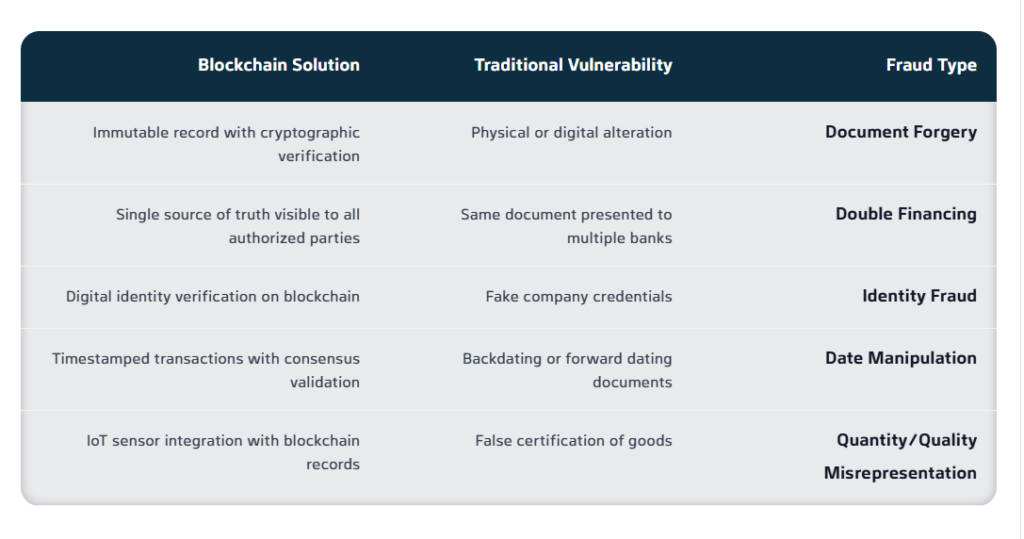
Technical Implementation Architectures
1 Blockchain Platform Selection for Trade Documents
Several blockchain platforms have emerged as leaders in trade document applications:
Hyperledger Fabric: Enterprise-grade permissioned blockchain particularly suited for trade finance consortia. Key features include:
- Modular architecture with pluggable consensus mechanisms
- Channel functionality for private transactions between specific parties
- Identity management through Membership Service Providers (MSP)
- Proven scalability with production deployments handling thousands of transactions per second
Ethereum Enterprise: Public blockchain with private implementations offering:
- Mature smart contract capabilities (Solidity)
- Large developer ecosystem and tooling
- Interoperability with DeFi applications for trade finance
- Growing regulatory acceptance in certain jurisdictions
Corda: Distributed ledger platform designed specifically for financial services:
- Unique “notary” concept for transaction finality
- Fine-grained privacy through transaction tear-offs
- Legal entity recognition and regulatory compliance features
- Strong adoption in banking and trade finance sectors
Trade-Specific Platforms: Specialized solutions like we.trade, Marco Polo, and Contour have built blockchain networks specifically for trade documentation and finance.
2 Document Tokenization and Digital Twins
The process of representing physical trade documents on blockchain involves:
Document Hash Creation Generating unique cryptographic fingerprints (hashes) of document content that are stored on-chain while the actual documents remain off-chain for privacy.
Digital Twin Creation: Creating blockchain-based digital representations of physical documents with synchronized status updates.
Tokenization of Document Rights: Representing document ownership and transfer rights as non-fungible tokens (NFTs) or other token standards that can be programmatically transferred and verified.
3 Integration with Existing Systems
Successful implementation requires integration with:
Enterprise Resource Planning (ERP) systems for document generation
Trade Finance Platforms for letter of credit and payment processing
Logistics Tracking Systems for shipment verification
Regulatory Reporting Systems for compliance documentation
Banking Interfaces for payment settlement
Implementation Case Studies and Results
1 Maersk-IBM TradeLens Platform
Background: Joint venture between Maersk and IBM creating a blockchain-based global trade digitization platform.
Document Security Implementation:
- Digital bills of lading with end-to-end visibility
- Immutable record of document transfers and amendments
- Automated compliance checks against sanction lists
- Integration with 150+ ecosystem partners including ports, customs, and logistics providers
Results (as of Q4 2024):
- 85% reduction in document processing time
- 40% decrease in document-related disputes
- Processing of 60+ million shipping events
- $1.2 billion in estimated annual savings for participants
- Zero successful fraud incidents on the blockchain component
2 we.trade Banking Consortium
Background: Consortium of 12 major European banks implementing blockchain for trade finance documentation.
Document Security Features:
- Digital purchase orders and invoices on blockchain
- Automated KYC and AML compliance
- Smart contract-based payment triggers
- Bank payment undertaking (BPU) digitization
Quantitative Outcomes:
- 70% faster document verification
- 95% reduction in manual document handling
- 30% decrease in trade finance processing costs
- 100% audit trail for regulatory compliance
- Expansion to 24 countries with 200+ corporate users
3 Singapore’s National Trade Platform (NTP)
Government-led Initiative: Singapore’s blockchain-based trade documentation system.
Key Components:
- Single window for all trade documentation
- Blockchain-based certificates of origin
- Integration with customs and regulatory bodies
- Interoperability with other national trade platforms
Impact Metrics:
- 80% reduction in document submission time
- 50% decrease in documentary compliance costs
- 25 million digital trade documents processed annually
- Model for 15+ other countries developing similar systems
Regulatory and Legal Considerations
1 Legal Recognition of Blockchain Documents
The legal status of blockchain-based trade documents varies by jurisdiction:
United Nations Model Law on Electronic Transferable Records (MLETR): Adopted by **45 countries** as of 2024, providing legal equivalence between electronic and paper trade documents.
Specific Jurisdictional Status:
Singapore: Electronic Transactions Act recognizes blockchain documents
United Kingdom: Law Commission recommendations for digital assets law reform
United States: State-level variations with growing federal guidance
European Union: Proposed Digital Finance Package including blockchain regulations
United Arab Emirates: Specific blockchain and digital asset laws in free zones
2 Compliance with International Standards
Blockchain implementations must align with:
International Chamber of Commerce (ICC) rules for documentary credits (UCP 600)
International Standby Practices (ISP98) for standby letters of credit
United Nations Commission on International Trade Law (UNCITRAL) model laws
Financial Action Task Force (FATF) recommendations for virtual assets
Basel Committee on Banking Supervision guidelines for crypto-asset exposures
.3 Cross-Border Regulatory Challenges
Implementing blockchain across jurisdictions presents challenges:
- Divergent legal recognition of electronic signatures and documents
- Varying data privacy regulations (GDPR, CCPA, etc.)
- Different anti-money laundering (AML) requirements
- Competing technical standards for blockchain implementation
- Tax treatment uncertainties for digital asset transactions
Implementation Challenges and Solutions

1 Technical and Operational Barriers
Interoperability Between Systems:
- Challenge: Multiple blockchain platforms and legacy systems
- Solution: Development of cross-chain protocols and API standardization
Scalability for Global Trade Volumes:
- Challenge: Processing millions of documents with sub-second verification
- Solution: Layer 2 solutions, sharding, and optimized consensus mechanisms
Data Privacy Concerns:
- Challenge: Balancing transparency with commercial confidentiality
- Solution: Zero-knowledge proofs, private transactions, and selective disclosure
Integration Complexity:
- Challenge: Connecting blockchain with existing enterprise systems
- Solution: Middleware platforms and gradual migration strategies
2 Organizational and Adoption Challenges
Industry Collaboration Requirements:
- Challenge: Need for multi-party participation to realize network effects
- Solution: Industry consortia formation and phased onboarding strategies
Change Management:
- Challenge: Resistance from stakeholders accustomed to traditional processes
- Solution: Comprehensive training, pilot programs, and clear value demonstration
Cost Justification:
- Challenge: Significant upfront investment with distributed benefits
- Solution: Consortium funding models and ROI analysis emphasizing fraud reduction
Future Trends and Evolution
1 Convergence with Complementary Technologies
The future of trade document security lies in technology integration:
Blockchain + Internet of Things (IoT): Real-time shipment tracking with automated document generation based on sensor data (temperature, location, tamper detection).
Blockchain + Artificial Intelligence: AI-powered fraud detection algorithms analyzing blockchain transaction patterns for suspicious activities.
Blockchain + Digital Identity: Self-sovereign identity systems for verified participant credentials across trade networks.
Blockchain + Regulatory Technology (RegTech): Automated compliance reporting and audit trails for regulatory authorities.
2 Emerging Standards and Protocols
Key developments shaping the future landscape:
Universal Trade Document Standards: Initiatives to create globally recognized digital document formats and data schemas.
Interoperability Protocols: Standards for communication between different blockchain trade platforms.
Digital Legal Frameworks Continued evolution of laws recognizing smart contracts and digital assets.
Central Bank Digital Currencies (CBDCs): Integration with blockchain trade systems for instant settlement.
3 Market Adoption Projections
According to Deloitte’s 2024 Global Blockchain Survey:
Current adoption: 35% of global trade finance utilizes some blockchain component
2026 projection: 65% adoption among major trading nations
2028 projection: 85% of cross-border trade documents will have blockchain verification
Market size: Blockchain in trade finance projected to reach $13.8 billion by 2029
Strategic Implementation Roadmap
For organizations implementing blockchain for trade document security:
Phase 1: Assessment and Planning (Months 1-3)
- Conduct fraud risk assessment and document flow analysis
- Evaluate blockchain platform options and consortium opportunities
- Develop business case with ROI projections
- Establish cross-functional implementation team
Phase 2: Pilot Design and Development (Months 4-7)
- Select pilot document type and trading partners
- Design technical architecture and integration approach
- Develop smart contracts and user interfaces
- Establish governance and operational procedures
Phase 3: Pilot Implementation and Testing (Months 8-10)
- Deploy pilot with limited scope and participants
- Conduct security testing and vulnerability assessment
- Gather user feedback and performance metrics
- Refine systems based on pilot learnings
Phase 4: Scaling and Expansion (Months 11-18)
- Expand to additional document types and trading partners
- Integrate with enterprise systems and partner platforms
- Develop internal expertise and support capabilities
- Establish continuous improvement processes
Phase 5: Optimization and Innovation (Months 19+)
- Implement advanced features (AI integration, IoT connectivity)
- Explore new use cases and revenue opportunities
- Participate in industry standards development
- Contribute to regulatory framework evolution
Conclusion

Blockchain technology represents a paradigm shift in how international trade documents are created, verified, transferred, and stored. By addressing fundamental vulnerabilities in traditional document systems, blockchain offers unprecedented security, transparency, and efficiency in global trade operations. While implementation challenges exist—particularly regarding interoperability, regulatory alignment, and organizational adoption—the demonstrated benefits in fraud reduction, cost savings, and process improvement make blockchain an essential component of modern trade infrastructure.
The transition to blockchain-based trade documentation is not merely a technological upgrade but a fundamental reimagining of trust mechanisms in global commerce. Organizations that embrace this transformation early will gain competitive advantages in security, compliance, and operational efficiency, while contributing to the development of more resilient and transparent global trade ecosystems
Meran Trading Company with years of brilliant history in the field of import, export, clearance of goods as well as domestic and foreign trade services.
The digitization and securing of international trade documents through blockchain is no longer a future possibility but a present necessity. With fraud losses mounting and regulatory requirements increasing, organizations cannot afford to rely on vulnerable traditional systems. Begin your blockchain journey with a comprehensive assessment of your current document vulnerabilities and potential implementation pathways. Our specialized team combines deep trade finance expertise with blockchain implementation experience across multiple industries and jurisdictions. Contact us today for a complimentary fraud risk assessment and discover how blockchain can transform your trade document security and efficiency..
Frequently Asked Questions (FAQ)
How does blockchain prevent document forgery in practice?
Each document receives a unique cryptographic hash stored on the blockchain. Any alteration to the document creates a different hash that won’t match the original, immediately revealing tampering. Document transfers require digital signatures from authorized parties, creating an immutable chain of custody.
What happens if there’s an error in a blockchain-recorded document?
Blockchain immutability doesn’t prevent correction—it ensures transparency in corrections. Errors are addressed by creating new, corrected versions of documents with clear references to the original. The audit trail shows both the error and correction, maintaining integrity while allowing necessary updates.
How do blockchain systems comply with data privacy regulations like GDPR?
Modern blockchain implementations use various privacy-preserving techniques: permissioned networks control data access, zero-knowledge proofs verify information without revealing it, and off-chain storage keeps sensitive data private while on-chain hashes provide verification. Legal frameworks are evolving to address blockchain-specific privacy considerations.
What is the cost comparison between traditional and blockchain-based document systems?
While initial implementation costs are higher for blockchain, operational costs are significantly lower. Traditional systems incur ongoing expenses for manual verification, fraud investigation, dispute resolution, and insurance. Blockchain reduces these costs through automation and prevention, typically achieving ROI within 18-24 months.
How do blockchain systems handle documents that require physical originals for legal purposes?
A: Hybrid approaches are emerging where blockchain serves as the primary system of record while physical documents are generated when absolutely required. Legal frameworks are increasingly recognizing digital equivalents, and technologies like QR codes on physical documents link to their blockchain records for verification.
– Smart Contracts in Trade Finance: The Future of Secure Transactions
– Blockchain in Export Documentation
– Digital Twins in Trade Logistics: The Future of Global Supply Chains